
How to Hire a QA Testing Company: What to Look For

Key Takeaways
- The right QA testing company acts as an extension of your engineering team, not a disconnected vendor throwing bug reports over the wall.
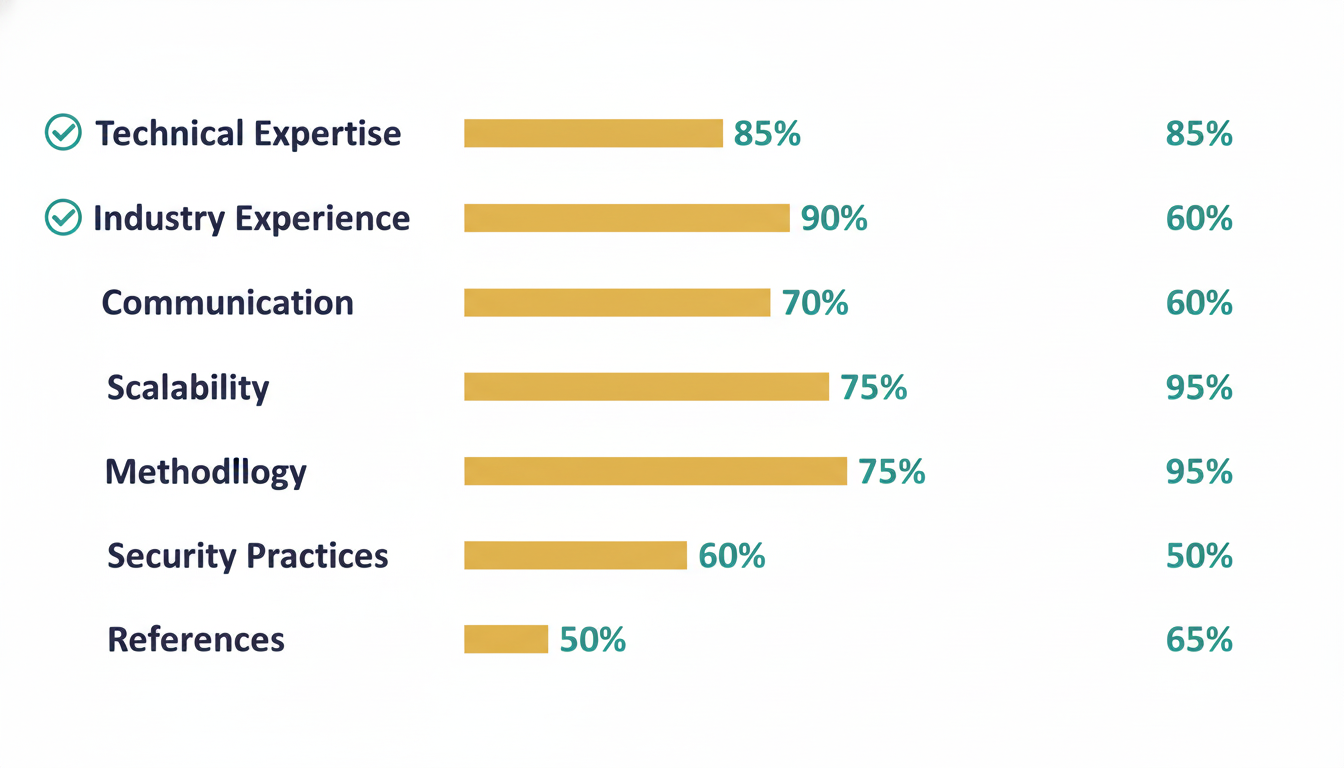
- Evaluate QA firms on five dimensions: domain expertise, technical depth, communication maturity, process rigor, and demonstrated results with comparable projects.
- Pricing transparency is a quality signal. Companies that cannot clearly explain their pricing model are likely to surprise you with scope creep and change orders.
- The cheapest option is almost never the best option. A QA team that costs 40% less but misses critical defects will cost you 10x in production incidents, reputation damage, and emergency patches.
- Start with a paid pilot engagement before committing to a long-term contract. Two weeks is enough to evaluate competence, communication, and cultural fit.
Why Companies Hire External QA Teams
Not every company needs to hire an external QA testing company. But most companies that think they do not need one are wrong. Here are the scenarios where outsourcing QA delivers the highest ROI:
Your Developers Are Testing Their Own Code
This is the most common and most dangerous anti-pattern. Developers have an inherent bias toward their own code. They test the happy paths they designed and unconsciously avoid the edge cases that expose their assumptions. Independent QA eliminates this blind spot.
You Are Approaching a Major Release
Product launches, platform migrations, and major feature releases are high-risk events. Bringing in a specialized QA team for a time-bound engagement lets you scale testing capacity without permanent headcount. After the release stabilizes, you scale back down.
You Operate in a Regulated Industry
Healthcare, fintech, telecom, and government software require documented testing processes, traceability matrices, and compliance evidence. Specialized QA firms understand these requirements and deliver audit-ready documentation as a standard deliverable.
You Need Specialized Testing Expertise
Performance testing, security testing, accessibility testing, and mobile device testing require specialized skills and infrastructure that most product teams do not maintain in-house. A QA firm brings both the expertise and the tooling.
What to Look For in a QA Testing Company
1. Domain Expertise
The best QA firm for your project is one that has tested similar products in your industry. A team that has tested fintech applications understands transaction integrity, regulatory compliance, and the specific edge cases that arise from currency handling and payment gateway integrations. A team that has only tested e-commerce sites will miss these nuances.
Ask for case studies in your vertical. At QAOcean, we publish our client results because we believe transparency builds trust. Our QA testing engagements span fintech (WalletHub), healthcare (EnMedical), telecom (ZTE Corporation), travel (SquadTrip), and enterprise software (D2Soft).
2. Technical Depth
A competent QA firm should be fluent in your technology stack. Ask specific technical questions:
- What automation frameworks do they use? Do they have experience with your frontend framework (React, Vue, Angular) and your backend language (Node.js, Python, Java, .NET)?
- How do they handle test data management? Do they generate synthetic data, use anonymized production data, or maintain curated test datasets?
- Can they integrate into your existing CI/CD pipeline? Do they have experience with your deployment platform (Vercel, AWS, GCP, Azure)?
- How do they approach API testing? Do they validate contracts, handle authentication flows, and test error scenarios systematically?
3. Communication Maturity
Technical skill without communication discipline is useless. Evaluate:
- Reporting cadence. Do they provide daily standups, weekly summaries, or both? What does a defect report look like?
- Bug report quality. A good bug report includes steps to reproduce, expected vs. actual behavior, severity classification, screenshots or videos, and environment details. Ask for a sample bug report.
- Escalation process. How do they handle critical defects discovered outside business hours? What is their SLA for blocker-severity issues?
- Tool integration. Can they work in your project management tool (Jira, Linear, GitHub Issues) and your communication platform (Slack, Teams)?
4. Process Rigor
Ask about their QA methodology:
- Do they create a formal test plan and test strategy document before execution begins?
- How do they prioritize test cases? Risk-based testing should be the answer.
- Do they maintain a requirements traceability matrix?
- How do they handle regression testing between releases?
- What is their defect lifecycle (new, assigned, in-progress, fixed, verified, closed)?
5. Demonstrated Results
Demand specifics. "We improved quality" is not a result. "We reduced production defect escape rate from 12% to 2% over a 6-month engagement" is a result. Ask for metrics, client references, and published case studies.
Red Flags When Evaluating QA Companies
- No case studies or client references. If they cannot point to specific results they have delivered, they are either too new or too embarrassed by their track record.
- Vague pricing with "it depends" answers. Every project has variables, but a competent firm should be able to give you a range based on your project description within a single conversation.
- Overemphasis on headcount. Selling you "10 QA engineers" is meaningless. What matters is what those engineers deliver - test coverage, defect detection rate, and release confidence.
- No automation capability. A QA firm that only offers manual testing is stuck in 2015. You need a partner that can build and maintain automated test suites.
- Rigid engagement models. If they only offer 6-month contracts with no pilot period, they are optimizing for their revenue, not your outcome.
QA Pricing Models Explained
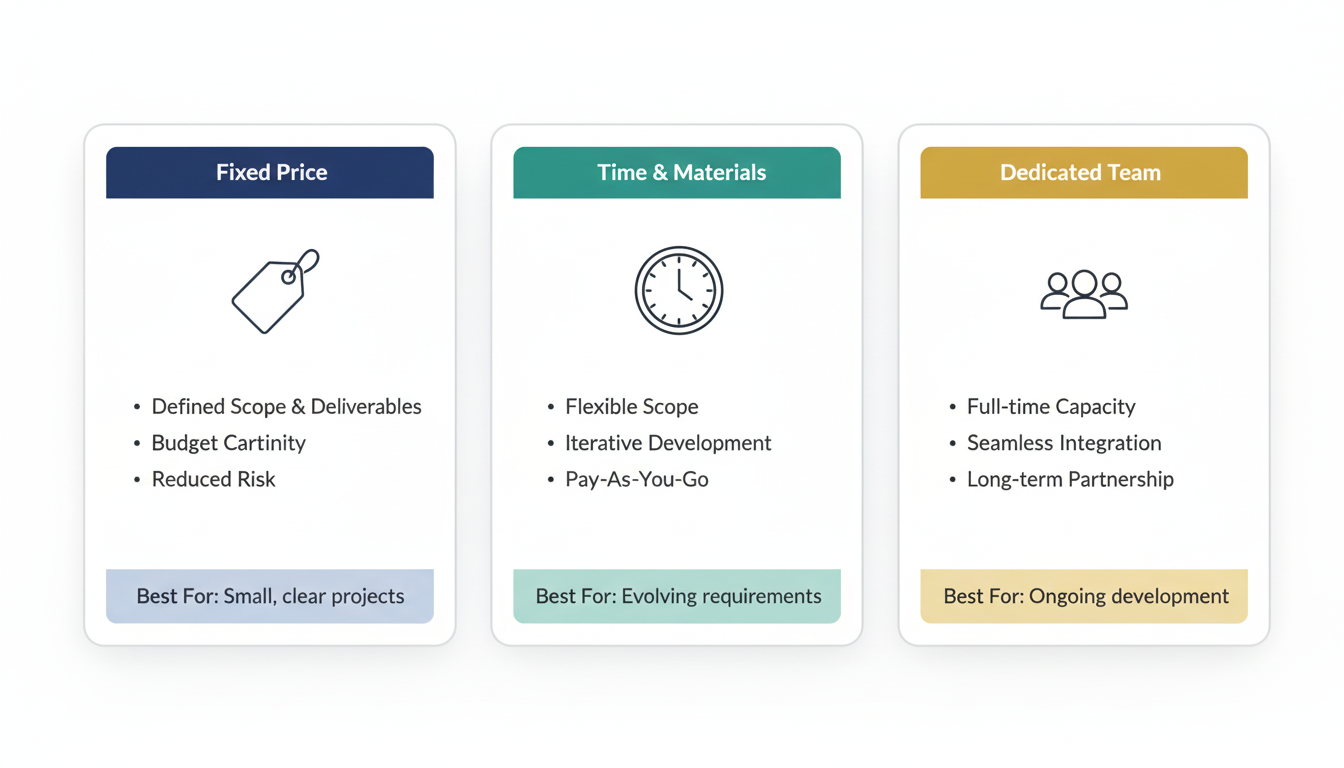
Time and Materials (T&M)
You pay for hours worked. This model offers flexibility but requires active management to control costs. Best for ongoing engagements where scope evolves.
Typical range: $40-$80/hour per QA engineer, depending on specialization and geography.
Fixed Price
The QA firm scopes the work, provides a fixed quote, and delivers within that budget. This model offers cost certainty but requires a well-defined scope upfront. Best for time-bound projects with clear boundaries.
Typical range: $5,000-$25,000 per engagement, depending on application complexity and test scope.
Dedicated Team
You hire a dedicated QA team that works exclusively on your project for a fixed monthly rate. This model offers continuity and deep product knowledge but requires enough work to justify full-time allocation.
Typical range: $3,000-$8,000/month per dedicated QA engineer.
Outcome-Based
A newer model where pricing is tied to deliverables or outcomes: number of test cases executed, defect escape rate targets, or release sign-off milestones. This model aligns incentives but requires mature measurement frameworks.
Visit our pricing page for transparent cost estimates across each engagement model.
How to Structure a QA Engagement for Success
Step 1: Start with a Paid Pilot (2 Weeks)
Never commit to a long-term contract without a trial period. A 2-week paid pilot gives you enough time to evaluate the team's technical ability, communication quality, and cultural fit. Define specific deliverables for the pilot: a test plan, a set of executed test cases, and a defect report.
Step 2: Define Clear Success Criteria
Before the engagement begins, agree on measurable outcomes:
- Target defect escape rate (e.g., fewer than 3 P1/P2 defects per release)
- Test coverage targets (e.g., 80% code coverage for automated tests, 100% coverage of critical user journeys)
- Reporting frequency and format
- Response time SLAs for critical defects
Step 3: Integrate, Do Not Isolate
The QA team should have access to your codebase, CI/CD pipeline, project management tools, and communication channels. They should attend standups, participate in sprint planning, and have direct access to developers. QA that operates in a silo produces low-quality results.
Step 4: Review and Iterate Monthly
Schedule monthly retrospectives to evaluate the engagement. Are defect escape rates improving? Is the team finding high-value bugs or just cosmetic issues? Is communication smooth? Adjust scope, team composition, and priorities based on data.
Questions to Ask Before Signing a Contract
- Can you share three client references in my industry?
- What does your onboarding process look like and how long does it take?
- How do you handle knowledge transfer if we end the engagement?
- What happens if a QA engineer on my project leaves your company?
- Do you provide test documentation that we own after the engagement?
- What is your defect classification system and escalation process?
- Can you integrate with our existing CI/CD pipeline and dev tools?
- What is your cancellation policy and minimum commitment period?
If you are evaluating QA partners and want a straightforward conversation about what a testing engagement would look like for your product, reach out to our team. We will give you an honest assessment of whether outsourced QA is the right move for your situation - and if it is not, we will tell you that too.
Frequently Asked Questions
How long does it take to onboard a QA testing company?
For a typical web or mobile application, expect 1-2 weeks for onboarding. This includes environment setup, codebase familiarization, test strategy design, and initial test case creation. Complex enterprise applications with multiple integrations may require 3-4 weeks. The onboarding period is an investment - rushing it leads to shallow testing that misses critical defects.
Should I hire a QA company or build an in-house QA team?
It depends on your testing needs, budget, and timeline. If you need QA capacity immediately for a specific project or release, outsourcing is faster and more cost-effective. If you have ongoing, high-volume testing needs and want to build deep product knowledge internally, an in-house team makes sense. Many organizations use a hybrid model: a small in-house QA lead who manages an outsourced testing team.
What is the difference between a QA testing company and a freelance QA tester?
A QA company provides a managed team with established processes, tooling, backup coverage, and management oversight. A freelance tester provides individual expertise but introduces single-point-of-failure risk - if they get sick, take vacation, or leave, your testing stops. For mission-critical applications, the reliability of a managed team outweighs the cost savings of a freelancer.
How do I measure the ROI of outsourced QA?
Track these metrics before and after the engagement: production defect count and severity, mean time to detect defects, mean time to resolve defects, customer-reported bug volume, app store ratings (for mobile apps), and developer time spent on bug fixes vs. new features. A successful QA engagement typically reduces production defects by 60-90% and frees 15-25% of developer time from reactive bug fixing to proactive feature development.