
What Is QA Testing? A Complete Guide for 2026
Key Takeaways
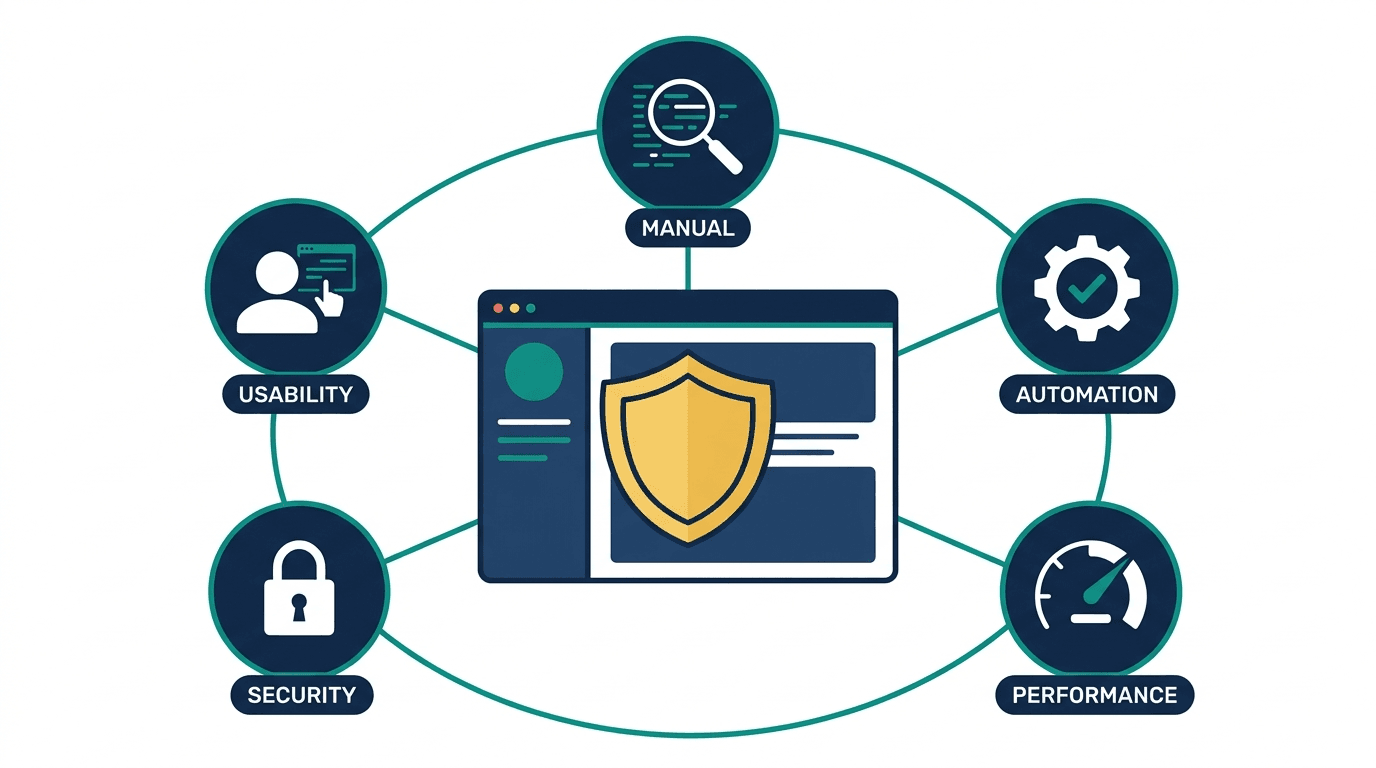
- QA testing is not just bug-finding. It is a structured engineering discipline that validates software against functional, performance, security, and usability requirements before users ever interact with it.
- Every dollar invested in QA during development saves $10 or more in post-release defect remediation, according to the National Institute of Standards and Technology (NIST).
- Modern QA in 2026 blends manual exploratory testing with AI-augmented automation, shift-left practices, and continuous testing embedded directly into CI/CD pipelines.
- Choosing the right QA strategy depends on your product type, release cadence, risk tolerance, and regulatory environment. There is no one-size-fits-all approach.
- Outsourcing QA to a specialized team accelerates coverage and eliminates blind spots that internal developers frequently miss because they are too close to the code.
What Is QA Testing? A Clear Definition
Quality Assurance (QA) testing is the systematic process of evaluating a software application to ensure it satisfies specified requirements, functions correctly across target environments, and delivers a reliable experience to end users. QA testing encompasses planning, designing test cases, executing tests, reporting defects, verifying fixes, and signing off on release readiness.
It is important to distinguish QA from QC (Quality Control). QA is process-oriented: it focuses on preventing defects through well-defined workflows, standards, and methodologies. QC is product-oriented: it focuses on detecting defects in the finished product. A mature software organization invests in both, but QA is the upstream investment that reduces the total cost of quality.
At QAOcean, our QA architects treat testing as a first-class engineering discipline. When our team partnered with WalletHub on their mobile QA initiative, we designed a testing strategy that covered 14 device-OS combinations and reduced production defect leakage by 87% within the first release cycle. That result was not accidental - it came from rigorous QA process design. Learn more about our approach on our QA Testing services page.
Why QA Testing Matters in 2026
Software quality expectations have never been higher. Users abandon applications after a single crash. App store algorithms penalize low-rated software. Regulatory frameworks like HIPAA, GDPR, and the EU AI Act impose direct liability for software failures. In this environment, shipping without QA is not bold - it is reckless.
Three trends make QA testing indispensable in 2026:
1. AI-Generated Code Requires AI-Grade Verification
With the widespread adoption of AI coding assistants, development velocity has increased dramatically. But faster code generation without proportionally faster QA creates a defect debt spiral. AI-generated code often passes basic linting but fails on edge cases, integration boundaries, and non-functional requirements. QA testing is the check valve that prevents AI-accelerated development from becoming AI-accelerated technical debt.
2. Shift-Left Testing Is Now Standard Practice
The shift-left movement has matured from a buzzword into an operational expectation. Teams that embed QA activities - static analysis, unit test reviews, testability assessments - into sprint planning and design phases catch 60-80% of defects before a single line of code is committed. This is not optional optimization; it is the baseline.
3. Continuous Deployment Demands Continuous Testing
Organizations deploying multiple times per day cannot afford manual regression gates that take days to execute. Automation testing suites that run in CI/CD pipelines provide the safety net that makes high-frequency releases sustainable.
Types of QA Testing
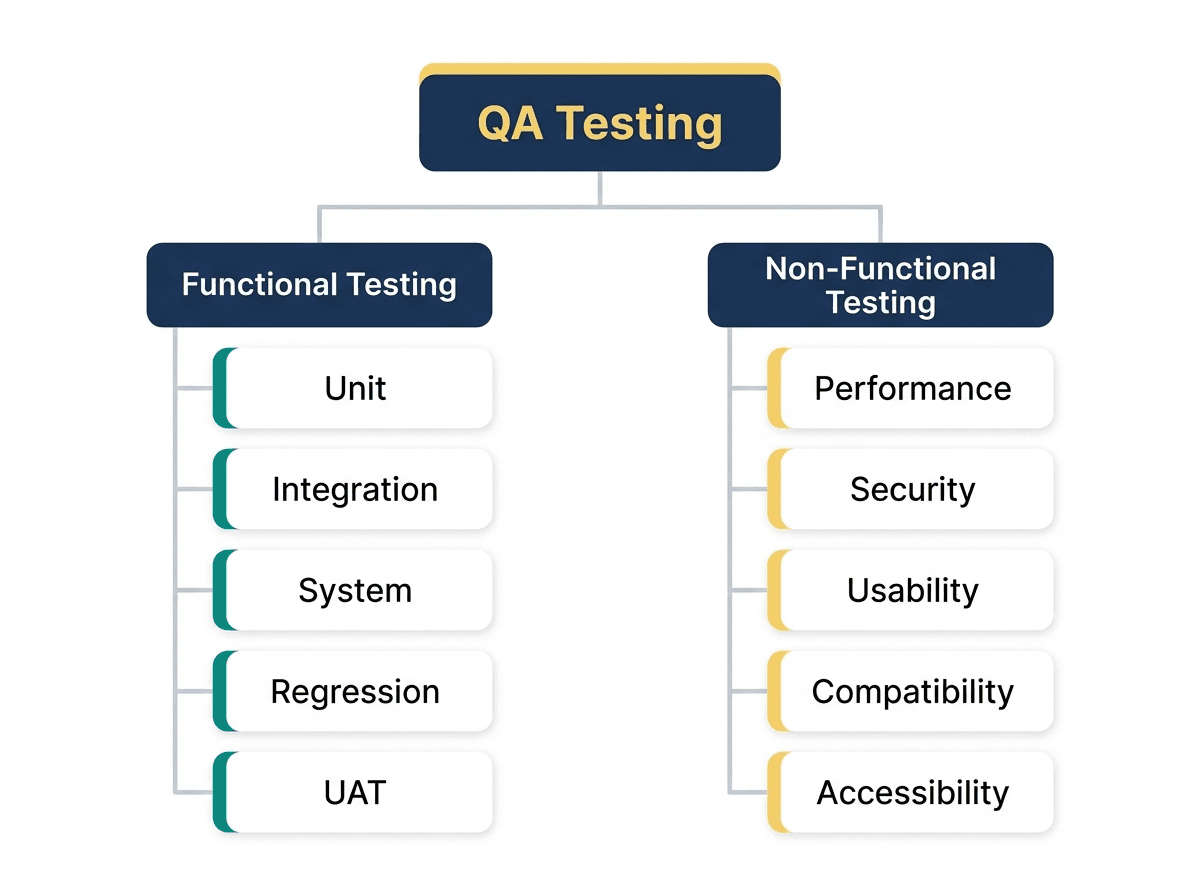
Functional Testing
Functional testing verifies that the software behaves according to its specifications. This includes:
- Unit Testing: Verifying individual functions or methods in isolation. Typically written by developers using frameworks like Jest, pytest, or JUnit.
- Integration Testing: Validating that modules or services work correctly when combined. API contract testing falls here.
- System Testing: End-to-end validation of the complete application in an environment that mirrors production.
- User Acceptance Testing (UAT): Business stakeholders confirm the software meets their requirements before release.
Non-Functional Testing
Non-functional testing evaluates attributes that are not tied to specific behaviors but are critical to user experience and operational stability:
- Performance Testing: Load testing, stress testing, and endurance testing to verify the system handles expected and peak traffic. Tools include k6, Gatling, and JMeter.
- Security Testing: Vulnerability scanning, penetration testing, and OWASP Top 10 assessments. This is mandatory for any application handling user data.
- Accessibility Testing: WCAG 2.2 compliance verification ensures the application is usable by people with disabilities. Beyond being the right thing to do, it is a legal requirement in many jurisdictions.
- Compatibility Testing: Verifying the application works across browsers, operating systems, devices, and screen resolutions.
Testing by Approach
- Manual Testing: A human tester interacts with the application, exercises workflows, and applies domain expertise to identify issues that automated scripts would miss. Exploratory testing is the highest-value form of manual testing.
- Automated Testing: Scripts execute predefined test cases, compare actual results against expected outcomes, and report failures. Selenium, Playwright, Cypress, and Appium are the dominant frameworks in 2026.
- Hybrid Testing: The approach our team recommends for most organizations. Automate the stable, repetitive regression suite. Reserve manual effort for exploratory testing, UX evaluation, and edge-case hunting.
QA Testing Methodologies
Waterfall QA
Testing occurs after development is complete. This model is largely obsolete for software but remains relevant in hardware-adjacent and regulated industries where design freezes are contractually mandated.
Agile QA
QA is embedded within each sprint. Testers participate in grooming, write test cases during sprint planning, execute tests during the sprint, and provide sign-off before the sprint review. This is the dominant model.
DevOps / Continuous Testing
QA is fully automated and embedded into the CI/CD pipeline. Every commit triggers a test suite. Failures block the deployment pipeline. Our team implemented this model for ZTE Corporation, where telecom-grade reliability requirements demanded zero-defect deployments.
How to Build an Effective QA Strategy
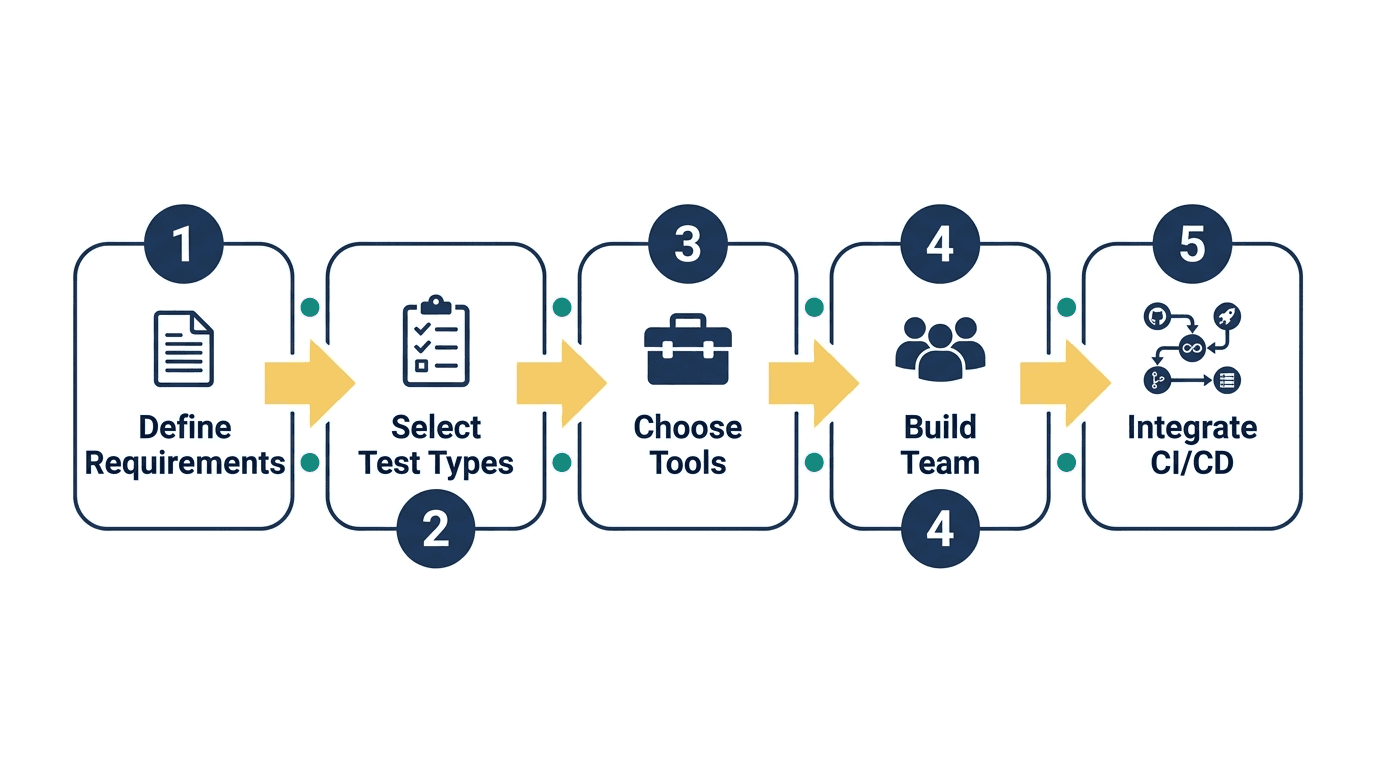
- Define quality objectives. What defect escape rate is acceptable? What are your SLAs for performance and availability?
- Map your risk profile. Which features carry the highest business risk if they fail? Prioritize testing there.
- Choose the right mix of manual and automated testing. Automate regression. Keep exploratory testing manual.
- Invest in test environments. Tests are only as reliable as the environments they run in. Containerized, production-mirrored environments are the standard.
- Measure and iterate. Track defect escape rate, test coverage, mean time to detect, and mean time to resolve. Use these metrics to continuously improve.
QA Testing Tools Landscape in 2026
| Category | Leading Tools |
|---|---|
| Test Management | TestRail, Zephyr Scale, qase.io |
| Browser Automation | Playwright, Cypress, Selenium |
| Mobile Automation | Appium, Detox, Maestro |
| API Testing | Postman, REST Assured, Hoppscotch |
| Performance Testing | k6, Gatling, Artillery |
| Security Testing | OWASP ZAP, Burp Suite, Snyk |
| Visual Regression | Percy, Chromatic, Applitools |
| AI-Augmented Testing | Testim, Mabl, Katalon |
When to Outsource QA Testing
Outsourcing QA to a specialized firm makes sense when:
- Your internal team lacks dedicated QA engineers and developers are self-reviewing their own code.
- You need to scale testing capacity for a major release without permanent headcount.
- Your product operates in a regulated domain (healthcare, fintech, telecom) and requires compliance-grade testing documentation.
- You want an independent, unbiased assessment of software quality.
Our team has delivered QA engagements across fintech, healthcare, telecom, and SaaS verticals. If your team is stretched thin and quality is slipping, talk to our QA architects about a testing strategy tailored to your stack and risk profile.
Frequently Asked Questions
What is the difference between QA and software testing?
QA (Quality Assurance) is the broader discipline that encompasses process design, standards, methodologies, and prevention of defects. Software testing is a subset of QA focused specifically on executing tests to find defects. A QA program includes testing but also includes code review processes, CI/CD pipeline design, test environment management, and release governance.
How much does QA testing cost?
QA testing costs vary based on scope, complexity, and duration. A dedicated QA engineer typically costs between $40-$80/hour depending on specialization. Outsourced QA engagements range from $5,000/month for ongoing support to $25,000+ for comprehensive pre-launch testing sprints. The real question is not what QA costs - it is what skipping QA costs. See our pricing page for transparent estimates.
Can QA testing be fully automated?
No. Automation handles repetitive regression testing efficiently, but it cannot replace human judgment for exploratory testing, usability evaluation, and testing scenarios that require domain expertise. The optimal approach is a hybrid model: automate the predictable, explore the unpredictable. Read our detailed comparison of manual vs automated testing.
How long does a QA testing cycle take?
A typical QA cycle for a medium-complexity web application takes 1-3 weeks for initial test design and execution. Subsequent regression cycles take 2-5 days with automation in place. For mobile applications, add time for device matrix testing. Our team delivered full QA coverage for WalletHub's mobile platform within a 4-week engagement, including test strategy design, execution, and defect resolution verification.
What certifications should a QA team have?
Look for ISTQB (International Software Testing Qualifications Board) certification as a baseline. For specialized domains, relevant certifications include CSTE (Certified Software Tester), security testing certifications like CEH or OSCP, and performance testing expertise with tools like k6 or Gatling. More important than certifications, however, is demonstrated experience with your specific technology stack and domain.