
API Development: REST vs GraphQL - Making the Right Choice
API Development: REST vs GraphQL - Making the Right Choice
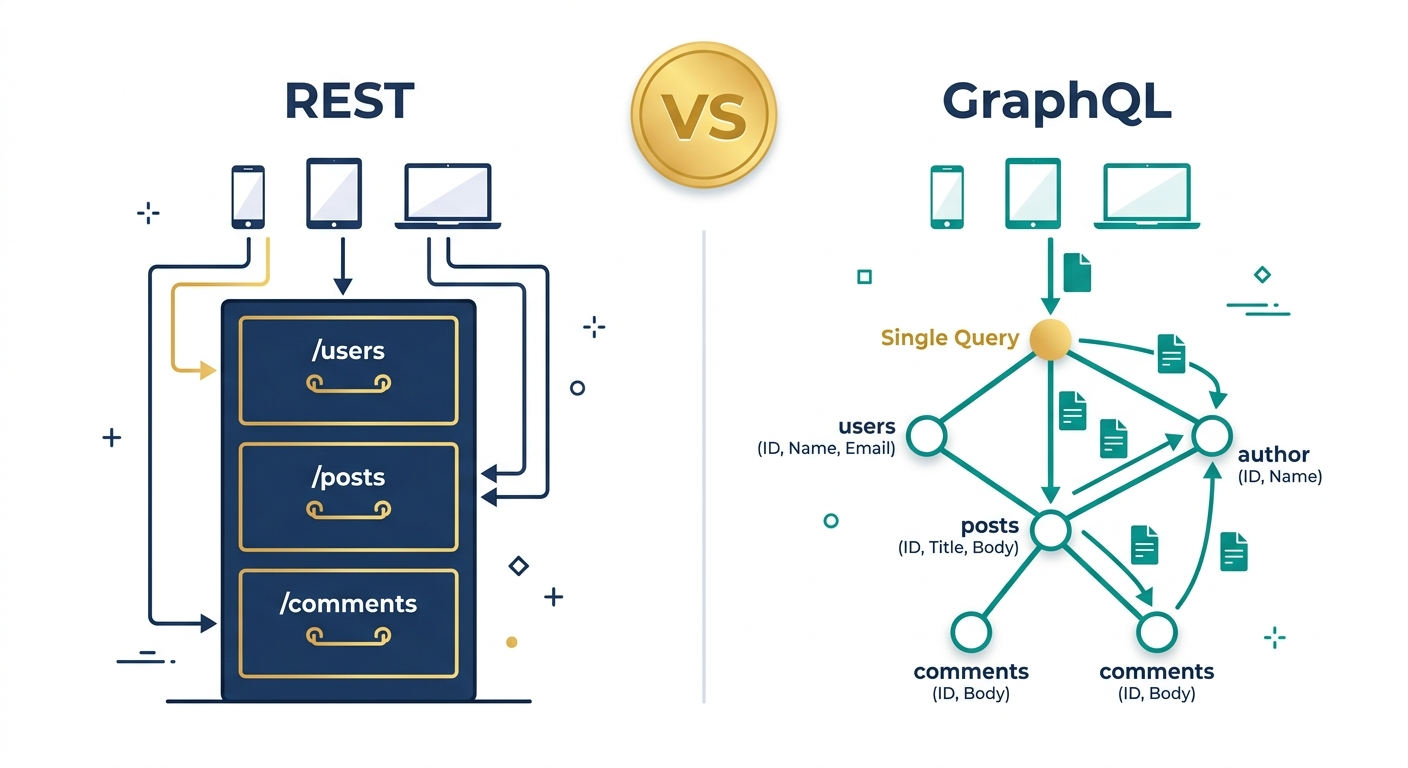
The REST vs GraphQL debate has matured significantly since GraphQL's public release in 2015. In 2026, the question is no longer "which is better?" - it is "which is better for this specific use case?" Both paradigms are production-proven at massive scale. REST powers the vast majority of public APIs, while GraphQL dominates complex frontend-driven applications at companies like Shopify, GitHub, and Airbnb. Making the wrong choice at the architecture level costs months of refactoring and introduces performance bottlenecks that compound as your product grows.
Our team at QAOcean has designed and built APIs across fintech, healthcare, and SaaS platforms. This guide distills what our engineers have learned from hundreds of API projects into a practical decision framework.
Key Takeaways
- REST is the better default for public APIs, simple CRUD services, and teams new to API design - its constraints make it predictable and cacheable.
- GraphQL excels when multiple clients (web, mobile, IoT) need different data shapes from the same backend, or when over-fetching is a measurable performance problem.
- The "use both" pattern is legitimate - many production architectures expose a REST API for external consumers and a GraphQL gateway for internal frontends.
- Neither solves bad data modeling - invest in your domain model before choosing a query paradigm.
- Performance differences are architectural, not inherent - a well-designed REST API outperforms a poorly designed GraphQL API, and vice versa.
Understanding REST: Strengths and Limitations
REST (Representational State Transfer) is an architectural style, not a specification. It relies on HTTP verbs (GET, POST, PUT, PATCH, DELETE), resource-oriented URLs, and stateless communication. A well-designed REST API is self-documenting: GET /api/v2/orders/42 tells you exactly what it does.
Where REST Excels
- Caching: HTTP caching works natively with REST. CDNs, browser caches, and reverse proxies all understand
Cache-Control,ETag, andLast-Modifiedheaders. For read-heavy APIs, this alone can reduce backend load by 80-95%. - Simplicity: Any developer who understands HTTP understands REST. Onboarding time is minimal, and debugging is straightforward with standard tools like curl, Postman, or browser DevTools.
- Ecosystem maturity: OpenAPI (Swagger) specifications enable automatic client generation, documentation, and contract testing. The tooling ecosystem is vast and battle-tested.
- Public APIs: When your API consumers are external developers, REST's predictability and universal familiarity make it the safer choice. Every programming language has robust HTTP client libraries.
Where REST Struggles
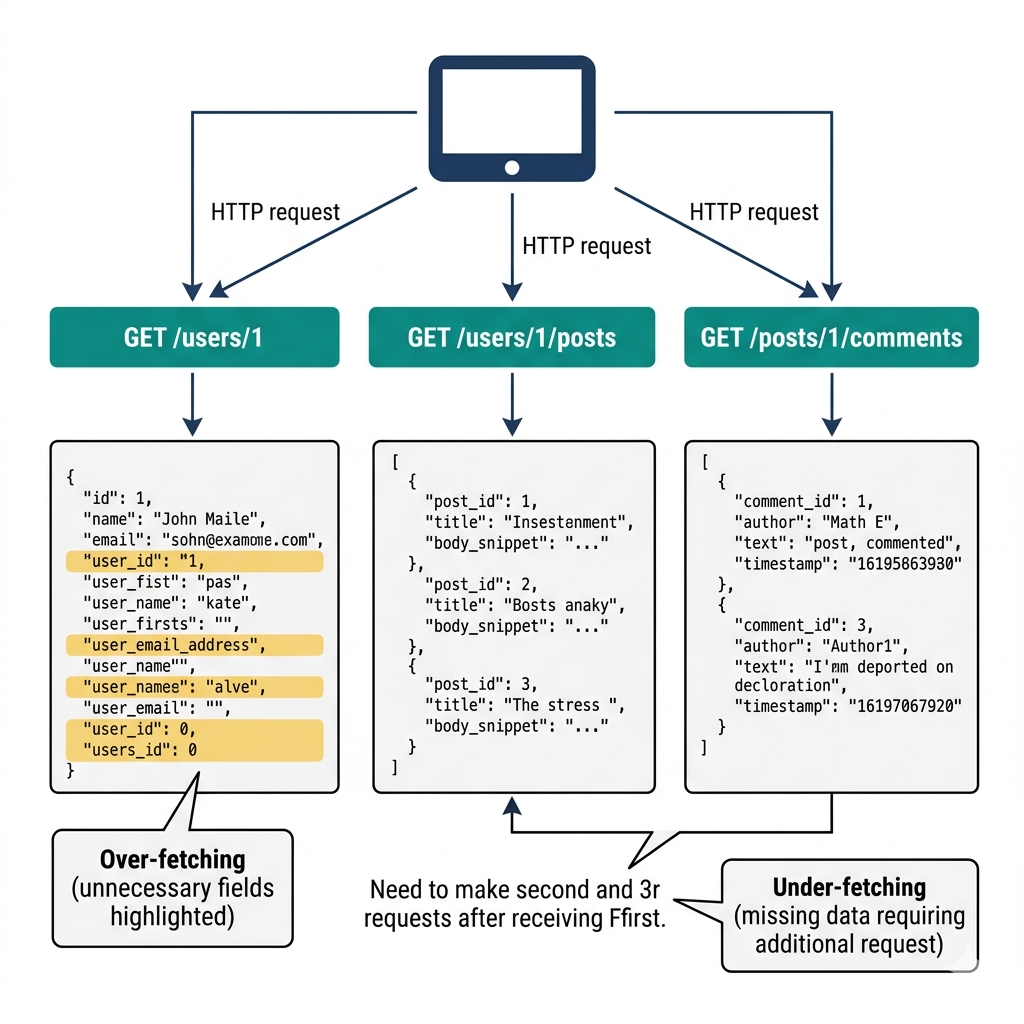
- Over-fetching: A
GET /users/42endpoint returns the entire user object, even if the client only needsnameandemail. Across dozens of endpoints and thousands of requests, this wasted bandwidth adds up - especially on mobile networks. - Under-fetching: Displaying a user's dashboard might require hitting
/users/42,/users/42/orders,/users/42/notifications, and/users/42/preferences- four round trips to render one screen. This is the N+1 request problem. - Versioning complexity: As your API evolves, managing v1, v2, and v3 endpoints becomes a maintenance burden. Each version is effectively a separate API surface that needs testing and documentation.
Understanding GraphQL: Strengths and Limitations
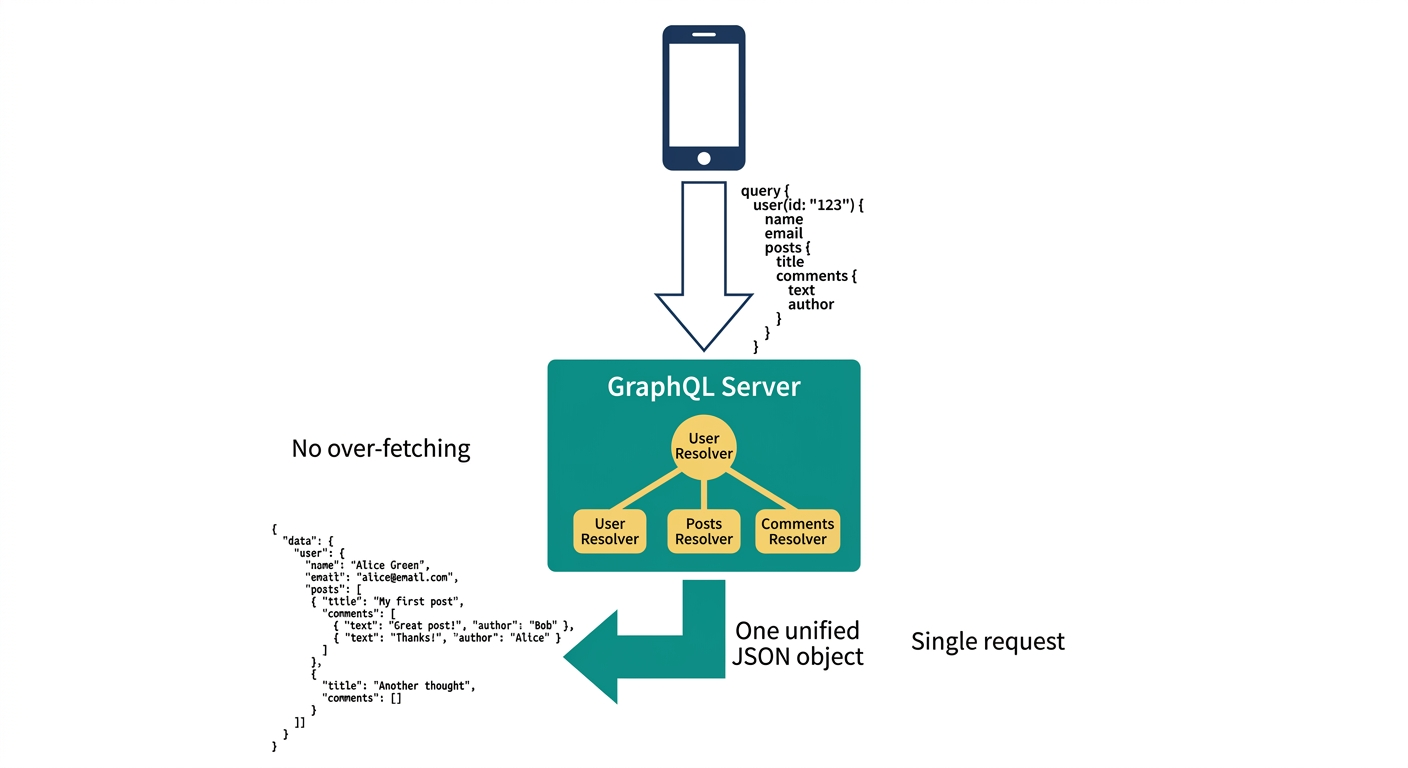
GraphQL is a query language and runtime for APIs. Clients send a query specifying exactly the fields they need, and the server returns precisely that shape - nothing more, nothing less. A single endpoint (POST /graphql) handles all operations.
Where GraphQL Excels
- Precise data fetching: Clients request only the fields they need, eliminating over-fetching. A mobile app requesting a user's name and avatar sends a different query than a desktop dashboard requesting the full profile - both hit the same endpoint.
- Single request composition: GraphQL queries can traverse relationships in a single request. Instead of four REST calls for a dashboard, one GraphQL query fetches the user, their orders, notifications, and preferences in one round trip.
- Strong typing and introspection: The GraphQL schema serves as a contract between frontend and backend. Tools like GraphQL Code Generator produce type-safe client code automatically, catching breaking changes at compile time rather than in production.
- Multi-client architectures: When web, mobile, and third-party integrations all consume the same API but need different data shapes, GraphQL's flexibility eliminates the need to build client-specific endpoints.
Where GraphQL Struggles
- Caching complexity: Because all requests go through a single POST endpoint, HTTP-level caching does not work natively. You need application-level caching solutions like Apollo Client's normalized cache or persisted queries.
- Query complexity attacks: Without safeguards, a malicious client can send deeply nested queries that overwhelm your server. You must implement query depth limiting, complexity scoring, and rate limiting at the resolver level.
- File uploads: GraphQL's specification does not cover file uploads natively. The community has settled on the multipart request specification, but it adds complexity compared to REST's straightforward multipart form handling.
- Learning curve: Resolvers, schemas, dataloaders, subscriptions, and federation are concepts that take time to master. Teams without prior GraphQL experience should factor in 4-8 weeks of ramp-up time.
Decision Framework: When to Choose Which
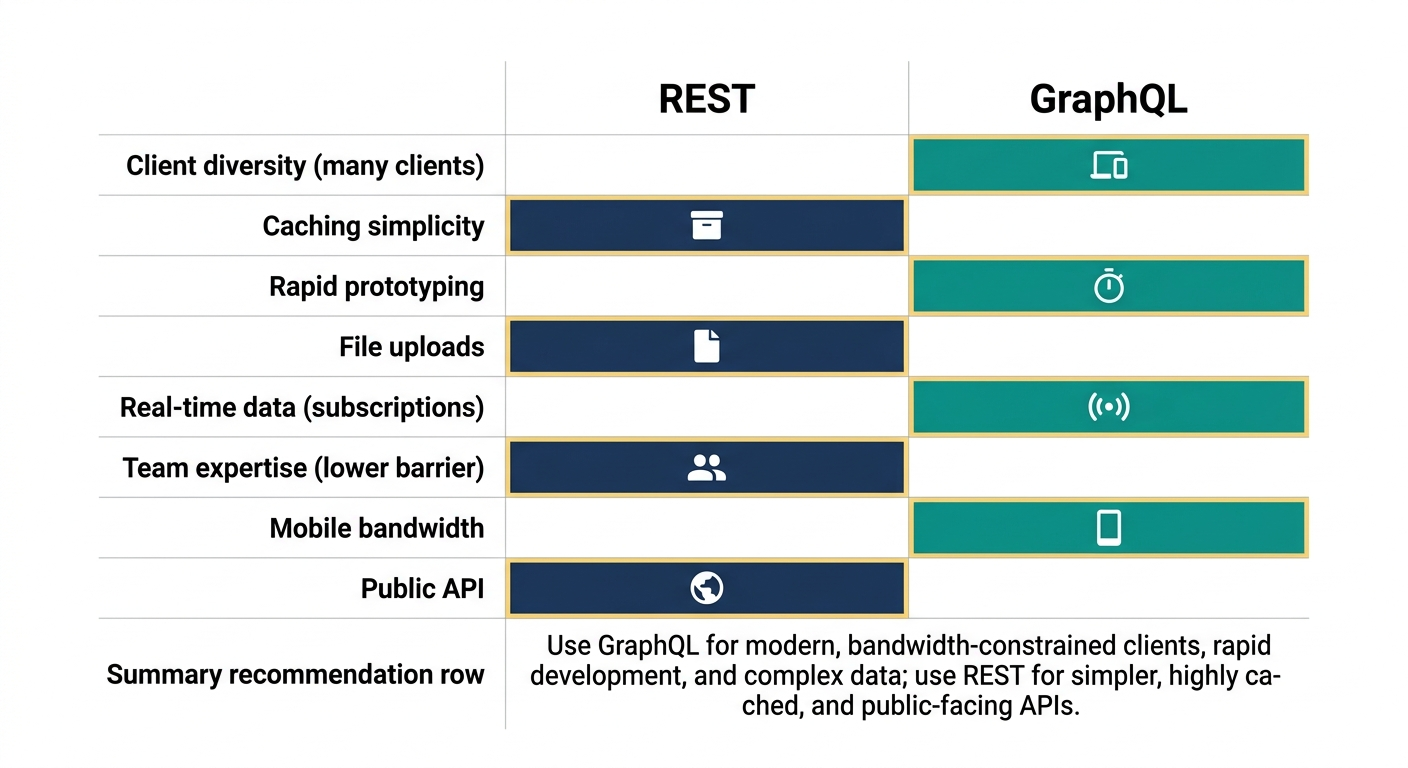
The right choice depends on your specific constraints. Here is the decision framework our engineers use when advising clients on API development projects.
Choose REST When:
- You are building a public API consumed by external developers.
- Your API is primarily CRUD operations on well-defined resources.
- HTTP caching is critical to your performance strategy.
- Your team has limited API design experience - REST's constraints guide you toward good patterns.
- You need maximum interoperability across languages and platforms.
Choose GraphQL When:
- You have multiple client types (web, mobile, IoT) with different data requirements.
- Your frontend team is blocked by backend endpoint development - GraphQL lets frontends request new field combinations without backend changes.
- Over-fetching or under-fetching is a measurable performance problem, particularly on mobile.
- Your domain model has complex relationships that are awkward to express as flat REST resources.
- You need real-time data via subscriptions (GraphQL subscriptions are more ergonomic than REST webhook patterns for client-facing real-time features).
Consider Both When:
Many production architectures at scale use both. A common pattern is:
- REST for external/public APIs: Predictable, cacheable, easy to document with OpenAPI.
- GraphQL as an internal API gateway: Aggregates multiple microservices behind a single schema for internal frontends.
This is the pattern our team implemented for a fintech client, where the public REST API served partner integrations while the internal GraphQL gateway powered the web dashboard and mobile app - reducing frontend data-fetching code by 60%.
Performance Optimization for Each Approach
REST Performance Best Practices
- Implement sparse fieldsets: Support
?fields=name,emailquery parameters to let clients request partial resources, mitigating over-fetching without abandoning REST. - Use compound documents: For related resources, support
?include=orders,preferencesto embed related data in the response, reducing round trips. - Leverage HTTP/2: Multiplexed connections make parallel REST requests nearly as efficient as a single GraphQL query for many use cases.
- Cache aggressively: Set appropriate
Cache-Controlheaders and implement conditional requests with ETags.
GraphQL Performance Best Practices
- Use DataLoader: Batch and deduplicate database queries at the resolver level. Without DataLoader, a query fetching 50 users with their orders can generate 50+ individual database queries.
- Implement persisted queries: Store approved queries on the server and reference them by hash. This eliminates query parsing overhead, prevents arbitrary query attacks, and enables CDN caching.
- Set complexity limits: Assign cost values to fields and reject queries exceeding a threshold. A nested
users { orders { items { reviews { author } } } }query should be rejected if its computed cost exceeds your limit. - Use @defer and @stream directives: These allow the server to send critical data immediately and stream less important data as it becomes available.
Real-World Architecture Patterns
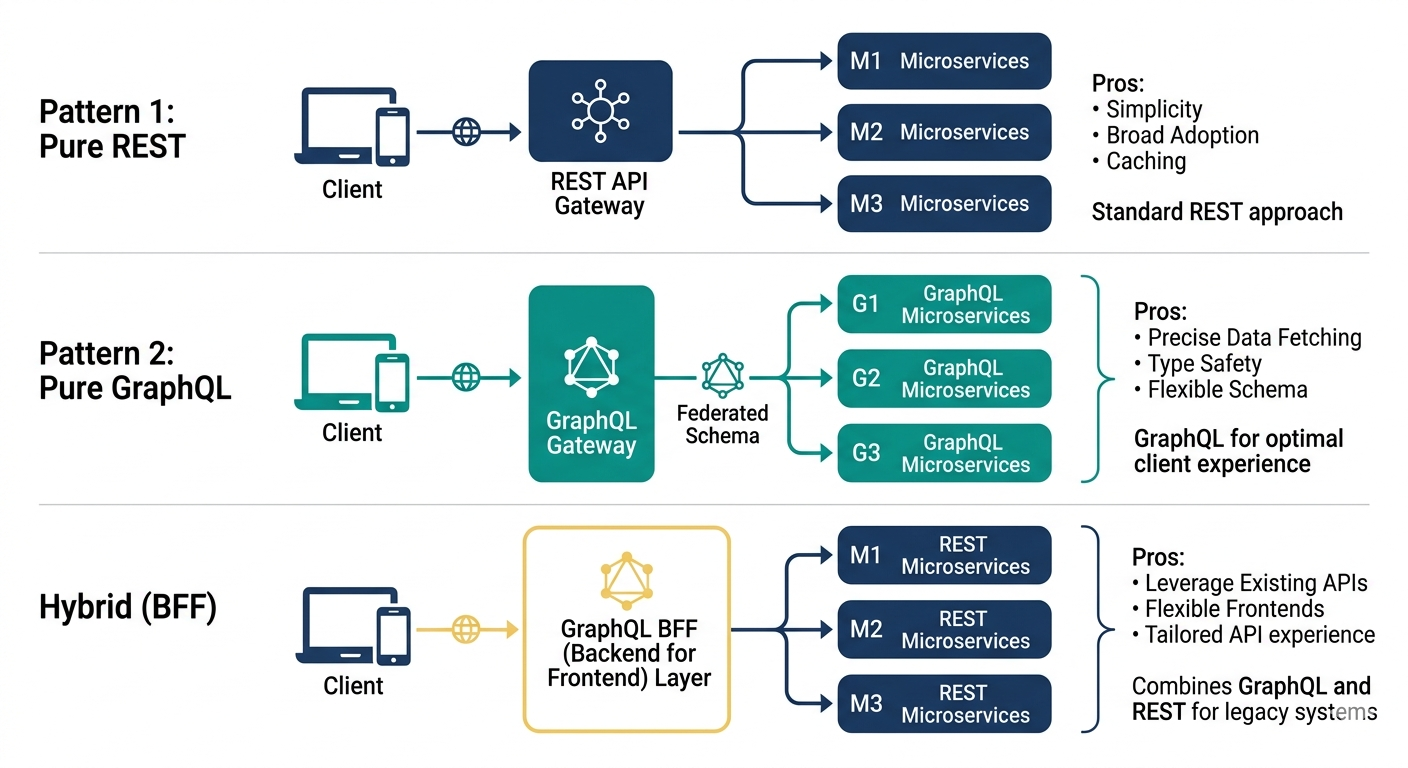
Pattern 1: REST Microservices with GraphQL Gateway
Individual services expose simple REST APIs. A GraphQL gateway (using Apollo Federation or GraphQL Mesh) stitches them into a unified schema. Frontend teams query the gateway; backend teams maintain independent REST services.
Pattern 2: GraphQL with REST Fallback
The primary API is GraphQL, but specific high-traffic endpoints (health checks, webhook receivers, file uploads) are implemented as REST endpoints. This is pragmatic and avoids forcing GraphQL where it adds friction.
Pattern 3: Backend-for-Frontend (BFF)
Each client (web, mobile, admin) gets its own lightweight BFF that aggregates downstream REST services. This achieves similar benefits to GraphQL - tailored responses per client - without introducing GraphQL's operational complexity.
Our web development team regularly implements all three patterns and can advise which fits your architecture best.
Common Mistakes to Avoid
- Choosing GraphQL because it is trendy: If your API is consumed by a single frontend with simple data needs, GraphQL adds complexity without proportional benefit.
- Treating REST URLs as RPC endpoints:
POST /api/getUseris not REST. If your "REST" API is just RPC over HTTP, neither REST nor GraphQL will save you from design problems. - Ignoring API versioning: Whether REST or GraphQL, you need a strategy for evolving your API without breaking existing clients. REST uses URL versioning or content negotiation; GraphQL uses schema evolution with deprecation directives.
- Skipping contract testing: Both REST and GraphQL APIs need automated contract tests to catch breaking changes before deployment. OpenAPI validators and GraphQL schema diffing tools are essential in any CI pipeline.
- Neglecting security: REST APIs need rate limiting, input validation, and proper authentication on every endpoint. GraphQL APIs need all of that plus query depth limiting and introspection disabling in production.
FAQ
Is GraphQL replacing REST?
No. As of 2026, REST remains the dominant API paradigm by a wide margin. Postman's State of APIs report shows that over 86% of public APIs are REST-based. GraphQL adoption continues to grow, particularly for internal APIs and frontend-driven applications, but REST is not going away. The two paradigms serve different needs, and the industry has moved past the "one must win" framing.
Can I migrate from REST to GraphQL incrementally?
Yes, and this is the recommended approach. Start by placing a GraphQL gateway in front of your existing REST services. The gateway's resolvers call your REST endpoints, and frontend teams begin consuming the GraphQL schema. Over time, you can migrate individual resolvers to call databases or services directly, retiring the REST intermediary where it no longer adds value. This approach carries minimal risk because the REST API remains functional throughout the migration.
Does GraphQL have better performance than REST?
Neither paradigm is inherently faster. GraphQL eliminates over-fetching and under-fetching, which can significantly improve perceived performance on bandwidth-constrained clients. However, REST APIs benefit from HTTP caching, which can make repeated requests essentially free. The real determinant of API performance is your data access patterns, database query efficiency, and caching strategy - not the query paradigm.
How does QAOcean approach API development?
Our API development team evaluates your specific requirements - client types, data complexity, team experience, performance targets, and integration constraints - before recommending an approach. We design schemas or resource models, implement the API with comprehensive testing, and set up monitoring and documentation. Whether REST, GraphQL, or a hybrid, we optimize for long-term maintainability and performance. Contact our team to discuss your API architecture.
Planning an API or rearchitecting an existing one? Our engineers have built APIs serving millions of requests across fintech, healthcare, and SaaS platforms. Get in touch with our team to design an API architecture that scales with your product.