
Full-Stack Development: Building Production-Ready SaaS Apps
Full-Stack Development: Building Production-Ready SaaS Apps
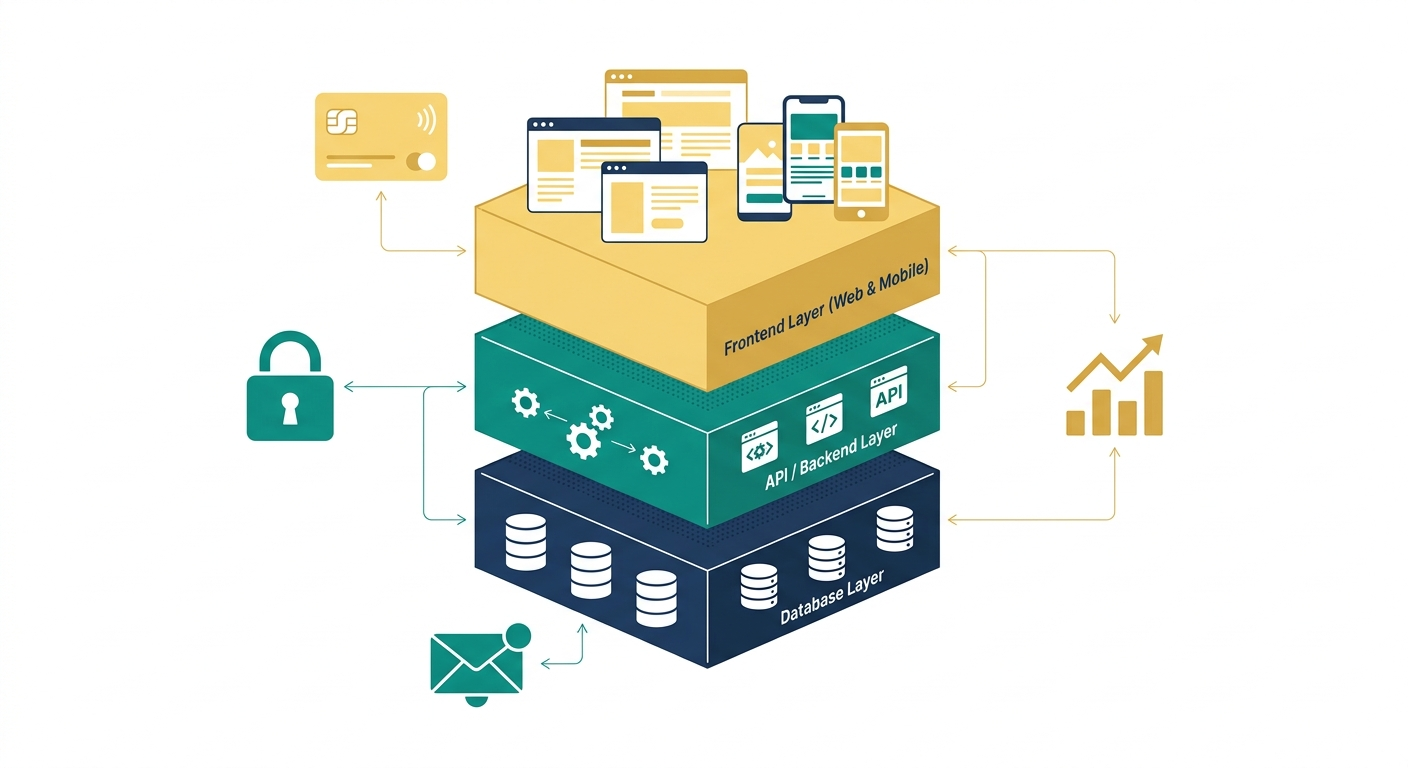
The barrier to launching a SaaS product has never been lower. Modern frameworks, managed databases, serverless infrastructure, and pre-built authentication services mean a skilled full-stack developer can go from idea to deployed MVP in weeks rather than months. But launching is not the hard part. The hard part is building a system that handles real traffic, processes real payments, survives real security threats, and scales without requiring a rewrite at every growth inflection point.
Production-ready SaaS development is about making hundreds of small decisions correctly - from database schema design and authentication architecture to error handling strategies and deployment pipelines. Our team at QAOcean has built and shipped SaaS platforms across fintech, travel, healthcare, and enterprise verticals through our full-stack development practice. This guide compiles the architectural decisions and engineering patterns that separate prototypes from production systems.
Key Takeaways
- Choose a monolith-first architecture - microservices add operational complexity that premature optimization does not justify until you have product-market fit and a team larger than 8-10 engineers.
- Multi-tenancy strategy must be decided at the database level before writing application code - retrofitting tenant isolation is one of the most expensive architectural changes in SaaS.
- Authentication and authorization are distinct concerns - use an identity provider (Clerk, Auth0, Supabase Auth) for authentication and implement authorization as an application-layer concern with role-based or attribute-based access control.
- Payments infrastructure requires idempotency at every layer - double-charging a customer is the fastest way to lose trust and trigger chargeback disputes.
- Observability is not optional - structured logging, distributed tracing, and real-user monitoring must ship with v1, not be added after the first outage.
Architecture: Start with a Modular Monolith
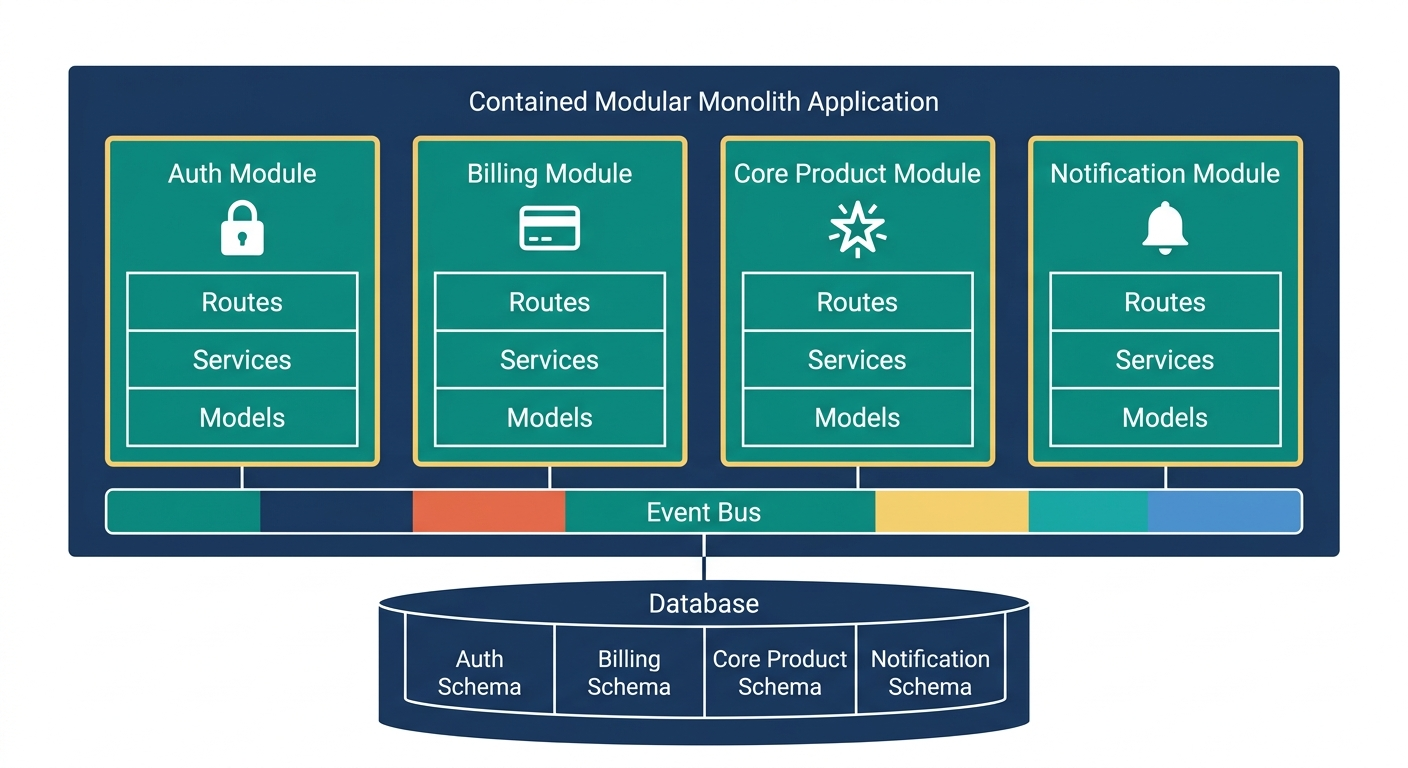
The default architecture for a new SaaS product should be a modular monolith - a single deployable unit with clear internal module boundaries that can be extracted into services later if needed. The modular monolith delivers the deployment simplicity of a monolith with the organizational clarity of service boundaries.
In a Next.js-based stack (the framework our team uses most frequently for SaaS products), this translates to:
- App Router for the web layer - server components for data fetching, client components for interactivity
- Server Actions for mutations that require server-side validation
- Domain modules organized by business capability (billing, users, teams, content) rather than technical layer (controllers, services, repositories)
- Shared kernel for cross-cutting concerns: authentication middleware, error handling, logging, and database client
This structure supports a team of 3-15 engineers working on the same codebase without stepping on each other's toes, and individual modules can be extracted into separate services when the organizational or scaling need arises - typically not until well past $5M ARR for most SaaS products.
Multi-Tenancy: The Decision That Shapes Everything
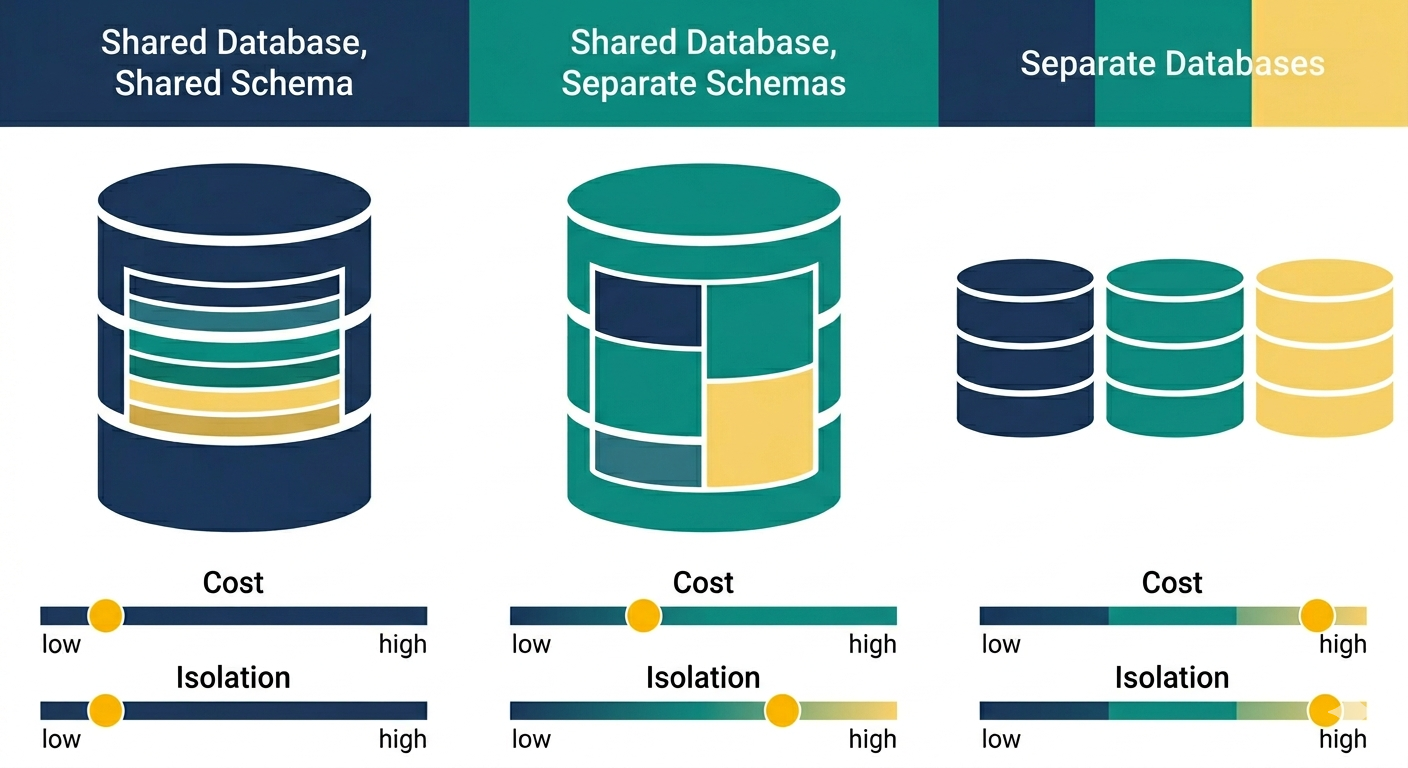
Multi-tenancy - the ability for a single application instance to serve multiple customer organizations - is the defining architectural characteristic of SaaS. The three multi-tenancy models are:
Shared Database, Shared Schema
All tenants share the same database tables, with a tenant_id column on every row. This is the simplest model and the right default for most SaaS products. It is cost-efficient, simple to manage, and scales well with proper indexing.
Critical requirement: Every database query must include a tenant filter. Missing a WHERE tenant_id = ? clause is a data leak. Our engineers enforce this through middleware that automatically scopes all ORM queries to the current tenant context, making cross-tenant data access impossible at the framework level.
Shared Database, Separate Schemas
Each tenant gets its own database schema within a shared database instance. This provides stronger isolation than shared schema and simplifies per-tenant backup and restore, but increases operational complexity for migrations (every schema must be migrated individually).
Separate Databases
Each tenant gets a dedicated database instance. This provides the strongest isolation and is required for enterprise customers with data residency requirements or compliance mandates. It is the most expensive model and the most operationally complex.
Our recommendation: Start with shared database, shared schema. Add separate database support for enterprise tier customers when the revenue justifies the operational cost.
Authentication and Authorization
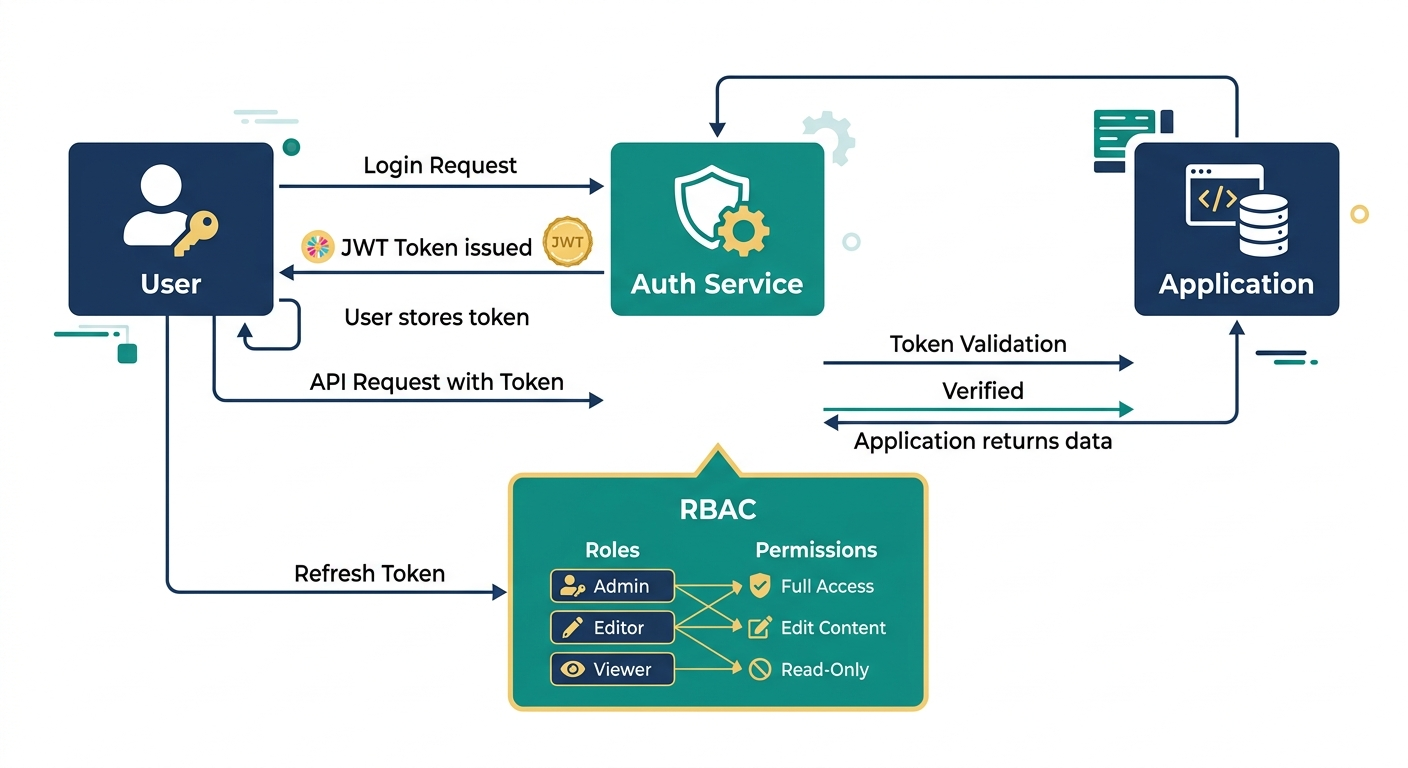
Authentication (who are you?) and authorization (what can you access?) are distinct concerns that should be implemented separately.
Authentication
For SaaS products in 2026, our team recommends using a managed identity provider rather than rolling your own authentication. Clerk, Auth0, and Supabase Auth handle password hashing, MFA, social login, email verification, session management, and security updates - all concerns that are high-risk, low-differentiation, and expensive to maintain.
Session management deserves special attention. JWTs (JSON Web Tokens) are popular but problematic for session management because they cannot be revoked without additional infrastructure. Our engineers prefer short-lived JWTs (15-minute expiry) paired with secure HTTP-only refresh tokens that can be revoked on the server side.
Authorization
Authorization in a SaaS product typically requires role-based access control (RBAC) at minimum, with attribute-based access control (ABAC) for more complex scenarios. A typical RBAC model includes:
- Organization-level roles: Owner, Admin, Member, Viewer
- Resource-level permissions: Create, Read, Update, Delete per resource type
- Team-based scoping: Users see only resources belonging to their team or organization
Implement authorization checks as middleware that runs before every request handler. Never rely solely on UI-level permission checks - an attacker with a valid session token can call API endpoints directly.
Payments and Subscription Billing
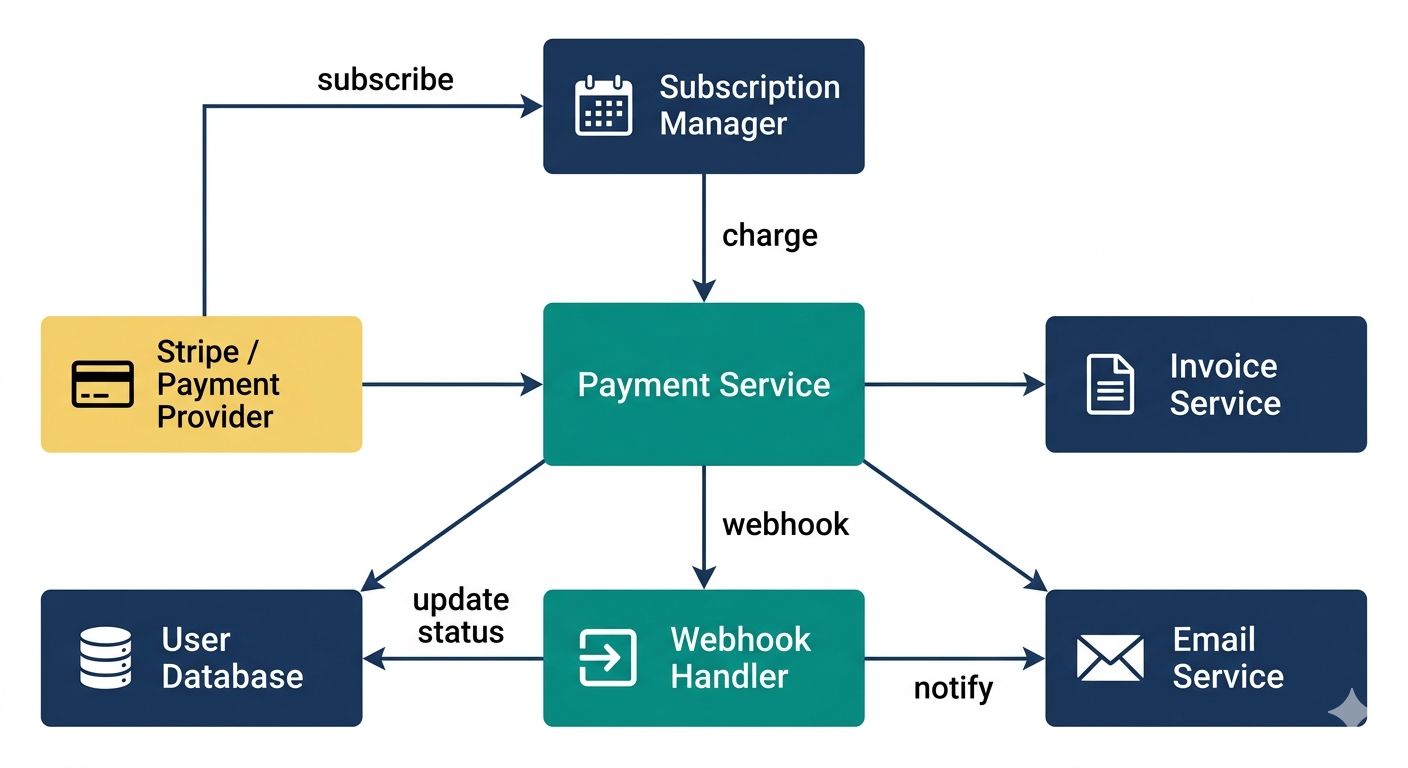
Payments are where SaaS engineering meets real financial consequences. Double charges, failed refunds, and incorrect proration destroy customer trust. Our team follows these principles:
Use Stripe as the system of record for billing state. Do not duplicate subscription status in your database. Instead, sync subscription state via webhooks and always verify against Stripe's API when making access control decisions. This eliminates an entire class of bugs related to stale billing data.
Implement idempotency keys on every payment operation. Network failures, retries, and webhook duplicates are not edge cases - they are normal operating conditions. Every mutation that touches money must be idempotent: retrying the same operation with the same idempotency key must produce the same result without creating duplicate charges.
Handle webhook events in the correct order. Stripe webhooks may arrive out of order. Process events based on the created timestamp in the event payload, and implement deduplication to handle the same event arriving multiple times.
Database Design for SaaS
PostgreSQL remains the best default database for SaaS applications in 2026, offering strong consistency, advanced indexing, full-text search, JSON support, and row-level security. Key design decisions include:
Use UUIDs for primary keys. Auto-incrementing integers leak information (a competitor can estimate your customer count by creating an account) and create merge conflicts in multi-region architectures. UUIDv7 (time-ordered) provides both uniqueness and index-friendly sequential ordering.
Design for soft deletes. SaaS customers expect to recover deleted data. Implement soft deletes with a deleted_at timestamp column and filter deleted records in application queries. Hard delete data only after a configurable retention period (30-90 days) to comply with data retention policies.
Implement row-level security (RLS) for tenant isolation. PostgreSQL's RLS feature enforces tenant isolation at the database level, providing a defense-in-depth layer that catches any application-layer bugs that might bypass tenant filtering.
Case Study: SquadTrip Travel Platform
Our team built the SquadTrip travel platform as a full-stack SaaS application handling group travel planning, itinerary management, and collaborative booking. The platform required real-time collaboration (multiple users editing the same itinerary simultaneously), integration with third-party booking APIs, and payment splitting across group members. We implemented a Next.js frontend with a PostgreSQL database, WebSocket-based real-time sync, and Stripe Connect for multi-party payments. The architecture supported 10,000+ concurrent users within six months of launch. This project exemplifies the web development approach our team applies across all SaaS engagements.
Performance Engineering for SaaS
SaaS performance directly impacts revenue. A 100ms increase in page load time reduces conversion rates by 7% (Akamai, 2025). Our engineers build performance into the architecture from day one:
Server-side rendering for initial page loads. Next.js Server Components render on the server and stream HTML to the client, eliminating layout shifts and reducing time-to-interactive. Use client components only for interactive elements - forms, modals, real-time features.
Edge caching for static and semi-static content. Marketing pages, documentation, and pricing pages should be statically generated at build time. Dashboard pages that change per-user should use ISR (Incremental Static Regeneration) or on-demand revalidation to serve cached content that refreshes on data changes.
Database query optimization. Every page load should require at most 3-5 database queries. Use query analysis tools (EXPLAIN ANALYZE in PostgreSQL) to identify slow queries, and add indexes for columns used in WHERE, JOIN, and ORDER BY clauses. N+1 queries are the most common SaaS performance antipattern - eliminate them with eager loading or DataLoader patterns.
CDN for static assets. All images, fonts, JavaScript bundles, and CSS files should be served from a CDN with aggressive cache headers (1 year for fingerprinted assets).
Deployment and Operations
A production SaaS application requires:
- CI/CD pipeline with automated testing, type checking, and linting on every pull request
- Staging environment that mirrors production configuration for pre-release validation
- Database migrations that are backward-compatible (no breaking schema changes in a single deployment)
- Feature flags for gradual rollouts and instant kill switches
- Structured logging with correlation IDs that trace a request through every service
- Error monitoring (Sentry) with alerting configured for new error types and error rate spikes
- Uptime monitoring with health check endpoints that verify database connectivity and external service availability
Frequently Asked Questions
Should I use a monorepo or separate repositories for frontend and backend?
For most SaaS teams under 15 engineers, a monorepo is the right choice. It enables atomic changes across frontend and backend (a new API endpoint and the UI that calls it ship in the same pull request), simplifies dependency management, and eliminates version synchronization issues. Tools like Turborepo and Nx handle build caching and task orchestration. Move to separate repositories only when distinct teams own distinct services and deploy independently.
When should I extract microservices from the monolith?
Extract a service when you have a clear organizational or scaling need - not before. Valid reasons include: a component needs to scale independently (e.g., a media processing pipeline), a separate team will own the component full-time, or the component has a fundamentally different deployment cadence. If none of these apply, keep it in the monolith. Premature microservice extraction is the single most common architectural mistake in SaaS startups.
How do I handle database migrations without downtime?
Zero-downtime migrations follow a three-phase pattern: (1) Add the new column or table without removing the old one, deploy application code that writes to both old and new locations. (2) Backfill historical data from old to new location. (3) Deploy application code that reads from the new location, then remove the old column or table. Each phase is a separate deployment, and the system remains fully functional between phases. Never rename or drop columns in a single deployment.
What is the minimum viable observability stack for a new SaaS?
Start with three pillars: structured logging (Pino or Winston with JSON output, shipped to a centralized log store like Datadog or Grafana Loki), error monitoring (Sentry with source maps for frontend and backend), and real-user monitoring (Vercel Analytics or a lightweight RUM script that tracks Core Web Vitals). Add distributed tracing (OpenTelemetry) and infrastructure metrics when you have more than one service or your team exceeds five engineers.
Ready to build a SaaS product that scales from day one? Contact our full-stack engineering team for an architecture review and development roadmap.